What Is CPR?
Imagine someone collapses at a market, viewing centre, or mosque. Their heart has stopped. An ambulance could take 30 minutes or more. What you do in the next few minutes could save their life.u
CPR (Cardiopulmonary Resuscitation) is a simple technique that keeps blood flowing to the brain when the heart stops. According to the World Health Organisation, immediate CPR can double or triple survival chances.
When Should You Perform CPR?
– Someone collapsing and is unconscious
– A person slumping at a bus park or motor park
– An elderly relative falling unconscious at home
– A colleague collapsing in the office
– A person pulled from water who is not breathing
– Someone who has suffered an electric shock and is unresponsive
What To Do: Step By Step
•First 30 seconds:
– Check the scene is safe
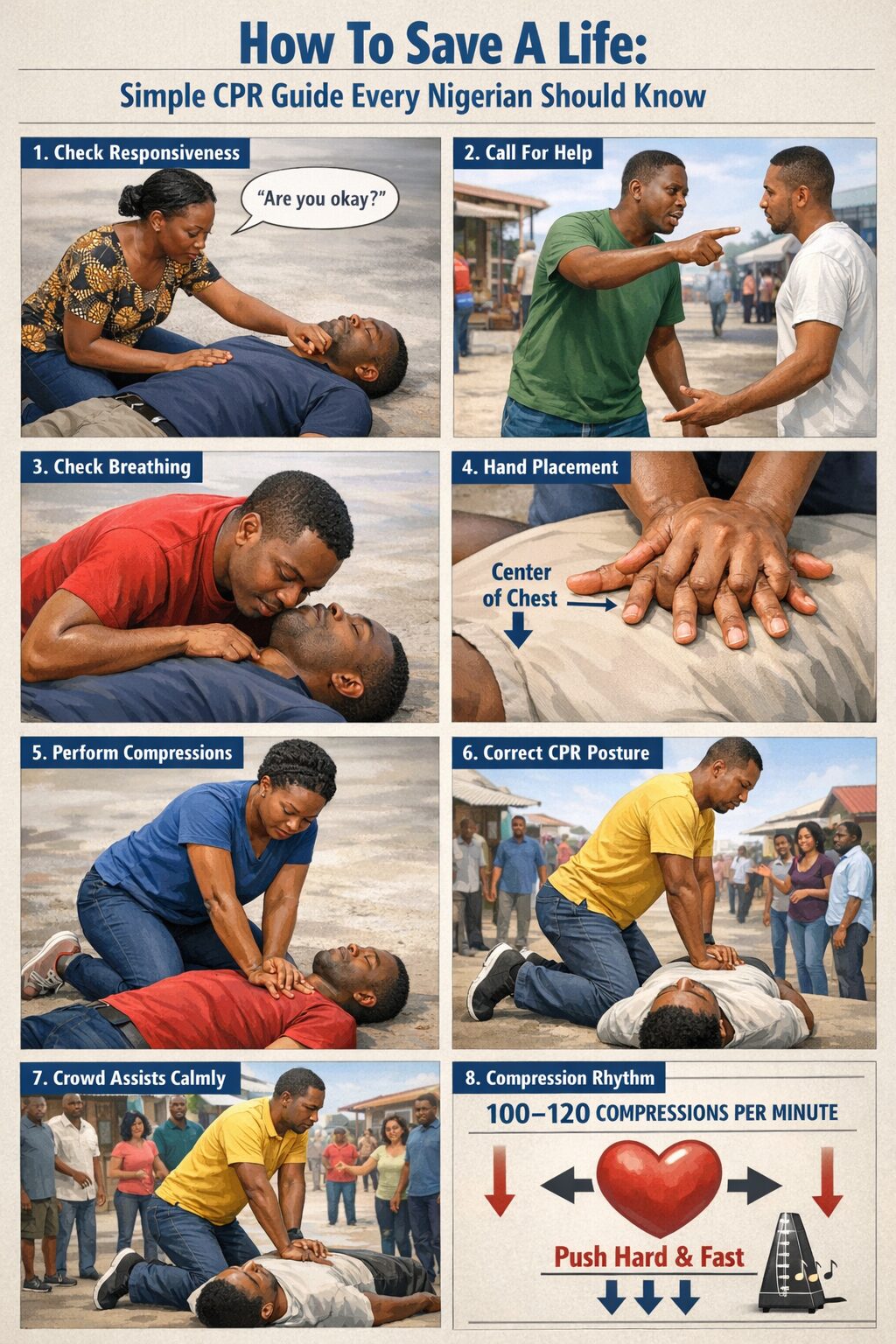
– Tap their shoulders and shout: “Can you hear me?”
– If no response, point at someone specific and say: “Call 112 now!”
– Check for breathing for no more than 10 seconds
READ ALSO: NARD, NMCN to Hospitals: Save Gunshot Victims’ Lives First Before Police Report
•Start hands-only CPR:
– Lay the person flat on a hard surface
– Place the heel of one hand on the centre of their chest between the nipples
– Place your other hand on top, interlock fingers
– Lock your elbows, push hard and fast — at least 5cm deep
– Aim for 100-120 compressions per minute
– Let the chest rise fully between compressions
– Do not stop until help arrives or someone takes over
Common Myths
Splashing water, forcing palm oil down their throat, or putting onion under their nose will not restart a stopped heart.
These practices can actually cause harm. Only chest compressions keep blood flowing to the brain.
Remember
You do not need medical training. Imperfect CPR is better than no CPR. As the Red Cross says: “The worst CPR is the CPR that never happens.”
Push hard. Push fast. Save a life.
Nigeria’s emergency number: 112