Executive Summary

Bank Excellence of Nigeria (BEN), a mid-tier commercial bank with over 200 branches
nationwide, embarked on a high-stakes IT infrastructure upgrade in mid-2024. The
migration from the aging T24 core banking system, widely used across African banks, to
a locally developed platform called SEABAAs aimed to enhance scalability,
customization for Nigerian regulatory needs, and cost efficiency. What began as a
strategic necessity spiraled into widespread operational disruptions, customer outrage,
and internal team paralysis.
At the epicenter was Megane Okoro, Branch Manager at BEN’s flagship Lagos Island
branch. Facing network downtimes, data glitches, rumor-fueled panic, and plummeting
staff morale, Megane’s initial reassurances failed amid escalating chaos.
Background: BEN’s Strategic Imperative
Founded in 1995, BEN had grown into a player in Nigeria’s competitive banking sector,
boasting 5,000 employees and serving retail, SME, and corporate clients across Lagos,
Abuja, Kano, and Port Harcourt. Its legacy T24 system, licensed from Temenos, had
powered operations for over a decade but buckled under rising demands: mobile
banking integration, real-time CBN compliance reporting, and Naira redesign volatility
post-2023.
In June 2024, BEN’s CEO, Dr. Aminu Bello, announced the upgrade at an all-staff virtual
town hall. “Our T24 is like an old Peugeot 504 on Lagos-Ibadan expressway—reliable
once, but now prone to breakdowns amid Third Mainland traffic,” he quipped, invoking a
familiar Nigerian metaphor. The new SEABAAs platform, built by Lagos-based fintech
firm Seabank Innovations, promised AI-driven fraud detection, seamless POS
interoperability, and 40% lower maintenance costs. The rollout timeline: pilot in July, full
migration by October 2024.
Staff reactions were mixed. Line managers like Megane, a 12-year BEN veteran with an
MBA from Lagos Business School, saw potential. “This could make us agile like
GTBank,” she told her 45-person Lagos Island team—a bustling branch handling high-
net-worth clients, salary accounts for oil firms, and forex trades. But whispers of “big
bang” migration risks—mass data transfers without parallel running—stirred unease.
Banking lore was rife with horror stories: a 2022 Access Bank glitch delaying
remittances for days; Zenith’s 2023 Flexcube switch causing ATM blackouts.
Competitor moves amplified pressure. Rival Unity Bank disclosed “routine IT
maintenance” around the same time, but Daily Trust leaks revealed a Phoenix-to-
Flexcube migration. “They’re leaping ahead while we’re tinkering,” a BEN trader
grumbled. Media headlines screamed “BEN’s Digital Leap or Plunge?”
The Rumor Mill Ignites Panic
By August 2024, informal channels lit the fuse. A WhatsApp group for BEN middle
managers buzzed with leaks: “Headcount cuts post-migration—redundancies from
automation.” Sourced from “a friend in HR,” the rumor tied into broader restructuring
whispers. Productivity dipped as staff hoarded tasks, fearing exposure.
Megane sensed the storm at Lagos Island. Her team—20 tellers, 10 customer service
reps, 5 relationship managers, and support staff—served 10,000 active accounts. Over
a hurried Friday huddle, she gathered them in the branch’s customer lounge. “Family,
I’ve heard the talks. Let me assure you: everything’s sorted. No jobs lost. This upgrade
will make us faster, stronger—like upgrading from PowerMike to Infinix Zero.” Laughter
eased tension momentarily, but eyes betrayed doubt. Megane’s optimism stemmed from
her climb from teller to manager via grit and loyalty, but she lacked executive intel.
Nationwide, similar scenes unfolded. In Abuja, a manager emailed staff: “Focus on
customers, not gossip.” But trust eroded as official communications stayed vague:
weekly CEO bulletins touted “90% testing success” without timelines.
Go-Live: From Anticipation to Chaos October 12, 2024: Migration Saturday. BEN shut
branches nationwide, notifying customers via SMS and app banners: “Exciting upgrade
ahead—services resume Monday brighter!” Behind scenes, 500 IT staff oversaw
petabyte-scale data migration: 20 million accounts, transaction histories since 1995.
Monday dawned disastrously. Nationwide network downtime crippled payments. An oil
firm’s payroll email ricocheted: “BEN failures processed zero salaries—workers
stranded.” Lagos Island tellers faced queues snaking to the street. “Madam, my kid’s
school fees!” a customer yelled. Megane manned the front, but glitches abounded:
balances vanishing mid-query, logins failing. Megane did not have immediate answers
to the challenges confronting her team. She depended heavily on technical experts to
resolve the downtime and the rising customer agitation. Acting quickly, she circulated
the procedures they provided to the tellers and customer service representatives and
issued the necessary directives. Yet, instead of restoring calm, the measures seemed to
heighten anxiety among both staff and customers.
To be fair, Megane could not be blamed entirely. Almost all line managers had received
no prior training on what to expect during the IT transition, and BEN’s culture did not
encourage experimentation, learning from mistakes, or genuine consultation with team
members. In fact, team-level scenario discussions were not part of the organization’s
normal way of working.
That Monday evening, Megane convened an emergency all-hands in the training room.
Fifty staff crammed in, faces gaunt. “Team, I know it’s rough. But BEN’s fixing it. By
week’s end, we’ll be golden. Stay strong—customers need our smiles.” Questions flew:
“Will bonuses pay?” “Are layoffs real?” Megane deflected: “Focus on now. All will
sort.” Avoiding tough talks, she micromanaged: barking orders, overriding teller
decisions. Her detail-oriented style morphed autocratic, “Process that withdrawal
manually, no excuses!” Stress compounded her woes; home life suffered as her
husband, a lawyer, urged rest.
Tuesday worsened: 11-hour digital blackout from 10 PM Sunday to 9 AM Monday.
BEN’s notification, “part of transition”—drew scorn on Twitter (#BENBlackout
trended). Protests erupted: placards at Ikoyi branch read “Pay My Money!” Police
dispersed crowds at Marina. Staff burnout surged; one teller fainted from heat and
harassment.
Megane’s confusion peaked. Her team, once cohesive, turned hostile. Tellers snapped
at customers: “It’s not our fault, blame IT!” Relationship managers dodged calls, hiding
in the back office.
Team symptoms spread:
• Paralysis: Staff froze on complex queries, escalating everything to Megane.
• Hostility: Frustrated outbursts at customers, risking complaints to CBN’s
consumer protection unit.
• Rumors: “SEABAAs is trash—back to T24!” WhatsApp groups exploded.
• Disengagement: Presenteeism ruled; productivity crashed 60%. Risk aversion
spiked—no upselling, no cross-sells.
Megane spent the first weekend pacing her Lekki apartment, replaying leadership
books: Dare to Lead by Brené Brown, Turn the Ship Around! by L. David Marquet, and
Leading in a Storm by Dakuku Peterside “It’s technical and psychological,” she realized.
She couldn’t fix servers, but she could rewire mindsets.
The Turning Point: Diagnosis and Experimentation
BEN’s executive team, alarmed by 30% transaction volume drop and fleeing deposits
(N50bn outflow), commissioned a “Migration Post-Mortem.” COO Fatima Yusuf tasked
branch managers: “Diagnose your house—what broke?”
Megane embraced it. Sunday night, she sketched a “Turbulence Diagnostic”:
1. Technical Gaps: SEABAAs training was cursory—two days vs. recommended 4-
6 weeks. Data hygiene issues from T24 legacy caused 15% error rates.
2. Psychological Toll: Uncertainty amplified by scarce info. Staff Maslach Burnout
scores (informal poll) hit “high” for exhaustion.
3. Leadership Void: Her avoidance bred distrust.
READ ALSO: ‘Nigeria Not Collapsing’, FG Says Security, Economy Improving
Willing to experiment, Megane piloted three interventions starting Week 2 post-
migration:
Intervention 1: Radical Transparency Town Hall
She hosted a no-holds-barred session, sharing her diagnostic raw. “I’m scared too.
SEABAAs has bugs, but BEN’s investing N2bn in fixes. Layoffs? Unconfirmed rumor—
HR says performance-based only.” She invited anonymous questions via Slido. Top
query: “Timeline?” Answer: “CBN-mandated stability by November 15.” Vulnerability built
psychological safety; applause followed.
Intervention 2: Empowerment Pods
Dividing into five “pods” (tellers, service, etc.), she delegated: “Own your fixes. Pod
leads report daily wins/challenges.” A teller pod created a “Quick-Fix Manual” for
common glitches—shared via WhatsApp. Risk-taking returned; one manager closed a
N10m SME loan amid chaos.
Intervention 3: Morale Boosters and Rituals
Daily “Gratitude Huddles”: 5 minutes sharing one win. “Team lunch Fridays” on BEN
(capped at N5k/branch). She modeled self-care: “I’m walking daily—join me?” Stress
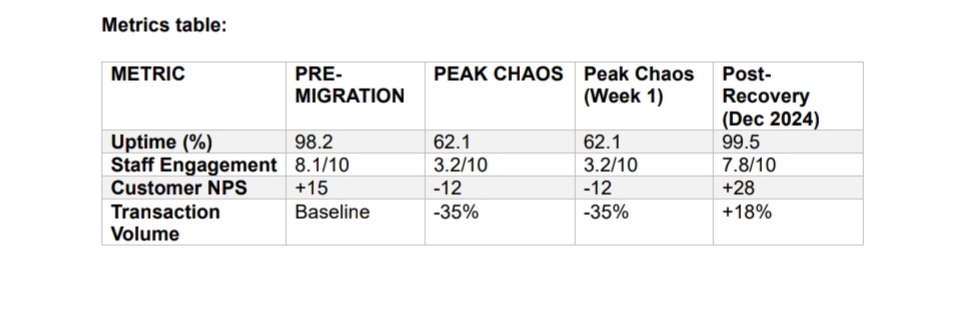
dipped; engagement polls climbed from 3.2/10 to 7.1/10.
Her team stirred. Initially skeptical, “Megane’s playing nice now?”—cooperation
bloomed. A customer service rep, Tunde, led pod training, turning frustration into
mastery.
BEN-wide, CEO Bello activated a “Stabilization Taskforce.” Wins included:
• Parallel T24/SEABAAs running by Week 3.
• 24/7 helpline staffed by 200 retrained reps.
• Customer goodwill: Free transfers, apology vouchers.
By December 2024, SEABAAs stabilized: 99.5% uptime, 25% faster transactions.
Deposits rebounded +15%. But scars lingered—staff turnover hit 12% (vs. 5% norm).
Lagos Island shone: Megane’s branch topped recovery metrics—productivity +40%,
NPS from -12 to +28. She earned “Manager of the Quarter,” crediting her team.
BEN’s post-mortem report pinpointed:
• Inadequate change management (no Prosci ADKAR training).
• Poor stakeholder comms (underestimated customer panic).
• Leadership gaps at line level.