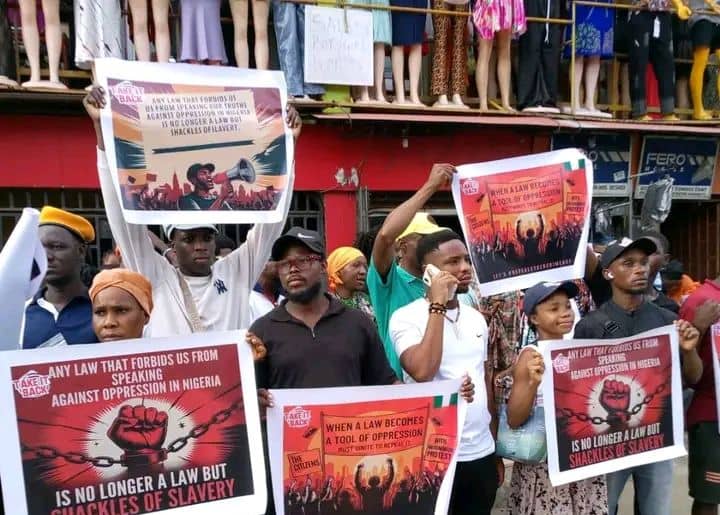
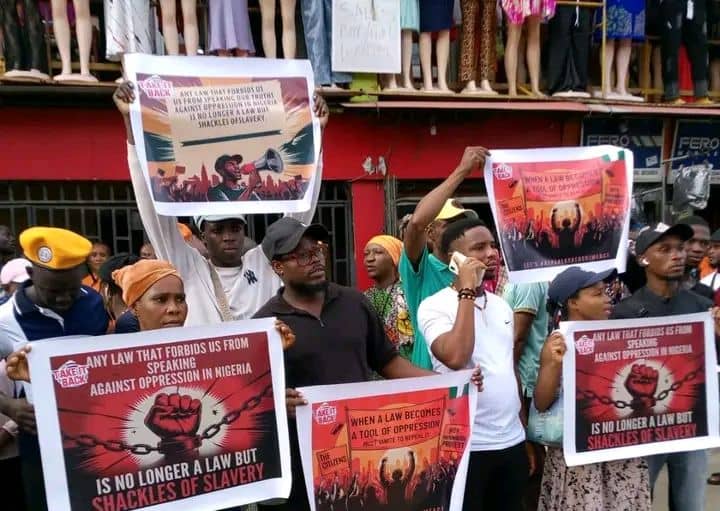
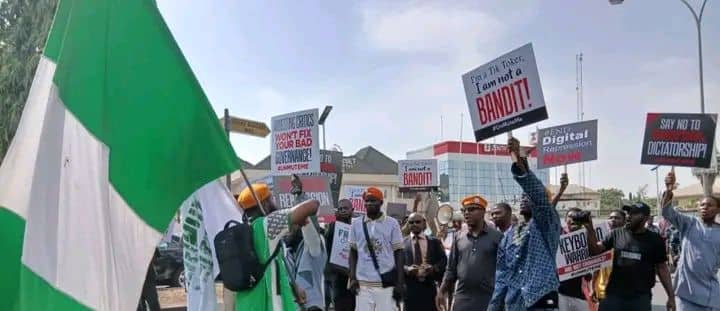
Young protesters under the banner of the Take-It-Back Movement defied police warnings and took to the streets on Monday in various cities across Nigeria, including Lagos, Abuja, Oyo, and Rivers. The demonstrators, clad in their distinctive orange berets, expressed their discontent over several pressing national issues, including the state of the Nigerian economy, the imposition of a state of emergency in Rivers State, and the controversial Cybercrime Act.
The protest, which began in Lagos at the Ikeja Under Bridge, saw a group of protesters marching through major roads in the state capital. As they chanted solidarity songs, they remained under the watchful eyes of police officers. Despite the heavy police presence, the demonstrators maintained a peaceful posture, although tensions rose in some locations, particularly in Rivers and Abuja.
Police Dispersal in Rivers State
In Rivers State, the protest took a tense turn as police officers in Port Harcourt resorted to firing tear gas at protesters at Isaac Boro Park. In a defiant stance, the protesters declared, “Nobody can tell us where not to gather, we are Rivers people,” in response to police orders to disperse. The protest in Rivers, unlike others, turned chaotic as law enforcement chased down demonstrators and reportedly clashed with journalists on the scene.
One protester, speaking to the media, explained that the peaceful demonstration was to express their grievances over what they described as unconstitutional governance in the state.
“We have no government. This government in Rivers State is alien to our people; it is unconstitutional. We are here to demand that our governor comes back to office and lead us appropriately. We have a social contract with the governor and not the sole administrator,” said the demonstrator.
The protesters also voiced their opposition to the ongoing implementation of the Cybercrime Act, a law they feel is being misused to stifle free speech.
The Rivers protesters had earlier submitted a letter to the police informing them of their intentions to hold the demonstration. However, tensions flared as security forces moved to prevent the rally. Several demonstrators were reportedly beaten, with journalists caught in the crossfire.
Abuja Protest Met with Tear Gas
Similarly, in Abuja, protests in the Maitama area were quickly dispersed when police used tear gas to scatter the crowd. As the demonstrators marched, they carried placards with messages such as “Stop the Repression” and “Let Us Breathe,” highlighting their concerns about the government’s approach to national issues. Among the key grievances voiced were the escalating economic hardship, the alleged misuse of the Cybercrime Act, and the controversial state of emergency imposed by President Bola Tinubu in Rivers State.
Human rights activist and former presidential candidate, Omoyele Sowore, was present at the Abuja protest, lending his support to the demonstrators.
READ ALSO: Abuja Erupts as ‘Take-It-Back’ Protesters Face Police Crackdown
Sowore’s involvement underscored the broader political context of the protests, with the movement drawing attention to what they see as an increasing authoritarianism under the current administration.
Nationwide Movement and Call for Change
The Take-It-Back Movement’s protests were part of a coordinated, nationwide demonstration calling for change. According to the movement’s National Coordinator, Juwon Sanyaolu, the protests were aimed at resisting the “increasing authoritarianism” of the government and demanding urgent relief for Nigerians grappling with inflation and insecurity.
Sanyaolu highlighted that the protests were not just about one issue but a broader resistance against what the movement perceives as an erosion of democratic freedoms in Nigeria.
“The government’s increasing authoritarian tendencies are a direct threat to the rights of Nigerians. The people’s voices must be heard,” he stated in a press release last week.
As the protests unfold across the country, the Take-It-Back Movement remains firm in its resolve to hold the government accountable and push for urgent reforms in areas affecting the economy, governance, and human rights. Despite the police’s heavy-handed response, the movement’s leaders, including Sowore, insist that their demonstrations are driven by the urgent need for social justice and democracy.
The events of Monday underscore the growing frustration among many Nigerians, as well as the mounting pressure on the government to address the issues raised by protesters in a peaceful and constructive manner.