
This week in Nigeria encapsulated the country’s deep-seated political tensions, with historical grievances, electoral integrity, and leadership conflicts taking centre stage.
Ohanaeze Ndigbo seized on Ibrahim Babangida’s revelation about the 1966 coup to demand ₦10 trillion in reparations. Goodluck Jonathan decried Nigeria’s flawed elections, blaming ghost voters and weak institutional integrity.
Meanwhile, President Bola Tinubu scrambled to hold his party together as cracks widened within the APC. In Lagos, ousted Speaker Mudashiru Obasa staged a dramatic power grab, storming the Assembly with armed police.
In the Senate, Natasha Akpoti-Uduaghan accused Godswill Akpabio of sexual harassment, escalating tensions in the upper chamber. These events reflect a nation struggling with its past, grappling with its present, and uncertain about its future.
1. Ohanaeze’s Reparations Demand: A Reckoning with History

The Igbo socio-cultural group Ohanaeze Ndigbo hailed former military ruler Ibrahim Babangida’s admission that the 1966 coup was not an Igbo-led plot. Seeing this as an opportunity for redress, the group demanded a public apology from the Nigerian government and ₦10 trillion in reparations for decades of marginalisation, war atrocities, and systemic discrimination.
Implication:
Babangida’s statement has rekindled historical wounds, yet it offers an opportunity for Nigeria to confront its past with honesty. However, the federal government is unlikely to entertain the reparation demand, given its financial constraints and reluctance to set a precedent for historical redress. This could further deepen ethnic grievances if not addressed with sincerity. A nation unwilling to acknowledge its past may find itself repeating it in different forms.
2. Jonathan’s Warning: Nigeria’s Elections on Shaky Ground

Former President Goodluck Jonathan criticised Nigeria’s electoral process, pointing to ghost voters, weak institutions, and political interference as obstacles to credible elections. Speaking at a democracy forum, he stressed that technology alone cannot solve Nigeria’s electoral flaws without principled leadership. He urged electoral officials to resign rather than bow to pressure from politicians, warning that regional and religious biases further erode trust in democracy.
Implication:
Jonathan’s concerns reaffirm Nigeria’s struggle to establish true electoral credibility. If unresolved, voter apathy will worsen, and democracy will continue to be a façade rather than a true reflection of the people’s will. Without meaningful electoral reforms, democracy in Nigeria remains a fragile illusion.
3. Tinubu’s APC Crisis: A Party at War with Itself

Amid internal disputes within the ruling All Progressives Congress (APC), President Tinubu appealed for unity, acknowledging discontent among party members. At an APC National Executive Committee meeting, he announced the formation of reconciliation committees in all states. This follows public criticisms from party heavyweights like Nasir El-Rufai and Rotimi Amaechi, while absences at the meeting—including former President Muhammadu Buhari—further signalled internal fractures.
Implication:
Tinubu’s effort to unify the APC comes at a critical time. With the 2027 election cycle looming, an internally divided ruling party is a weak one. The absence of key figures like El-Rufai and Amaechi, from the NEC meeting suggests that not all grievances can be settled with mere appeals. If left unresolved, internal discord could undermine the APC’s hold on power, embolden opposition forces, and destabilise governance at the federal level.
4. Obasa’s Assembly Takeover: A Political Coup in Lagos

Sacked Lagos Assembly Speaker Mudashiru Obasa staged a dramatic return, storming the House with armed police and declaring himself Speaker. His reappearance came just hours after security details for his successor, Mojisola Meranda, were mysteriously withdrawn.
Implication:
This brazen display of force by Obasa, underscores Nigeria’s increasing normalisation of power grabs at all levels of government. If unresolved, it could embolden similar moves elsewhere in the country, further eroding democratic norms. The incident also raises questions about who authorised the withdrawal of Meranda’s security and whether state actors are complicit in Obasa’s return. Lagos, Nigeria’s economic hub, cannot afford a prolonged legislative crisis, yet this episode suggests the battle is far from over.
5. Akpoti-Uduaghan vs Akpabio: A Senate Scandal
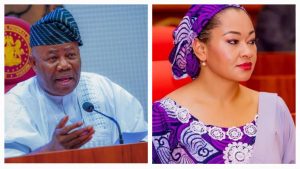
Senator Natasha Akpoti-Uduaghan accused Senate President Godswill Akpabio of sexual harassment, alleging he blocked her motions after she rejected his advances. The accusation follows weeks of tension, including her removal as chair of the Senate Local Content Committee and an unexplained seat change within the chamber. She has now taken legal action, suing Akpabio and the Nigerian government for defamation.
Implication:
This scandal could have serious repercussions for Akpabio’s leadership and the Senate’s credibility. If not properly handled, it risks deepening gender-based discrimination in Nigerian politics, where women already face systemic barriers. The case also puts Tinubu in a difficult position—should he distance himself from Akpabio or risk damage to the APC’s public image? How this controversy unfolds could shape the Senate’s leadership and expose deeper power struggles within the ruling party.
Conclusion
This week’s political developments reflect Nigeria’s deep-seated challenges—unresolved historical grievances, a fragile electoral system, party disunity, legislative disorder, and allegations of abuse of power at the highest levels. These issues are not isolated; they are symptoms of a nation grappling with the consequences of weak institutions and an entrenched political elite resistant to reform.
Yet, within this turmoil lies an opportunity for national introspection. Can Nigeria break free from the cycles of historical denial, electoral fraud, and impunity? Can political leadership prioritise justice over power consolidation? The answers will determine whether Nigeria progresses toward a truly democratic society or remains trapped in the shadows of its past.