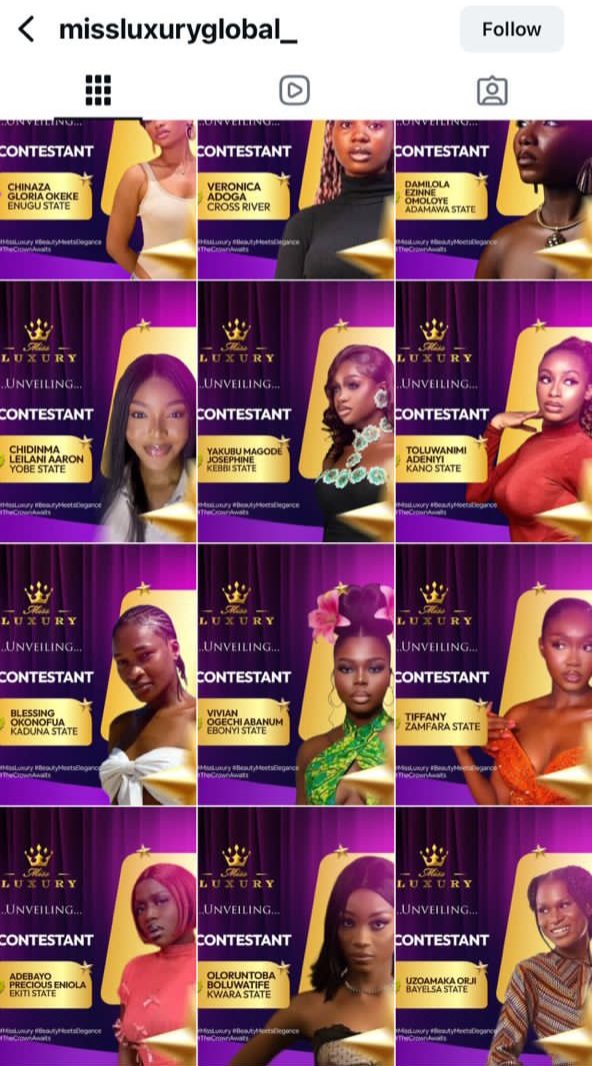
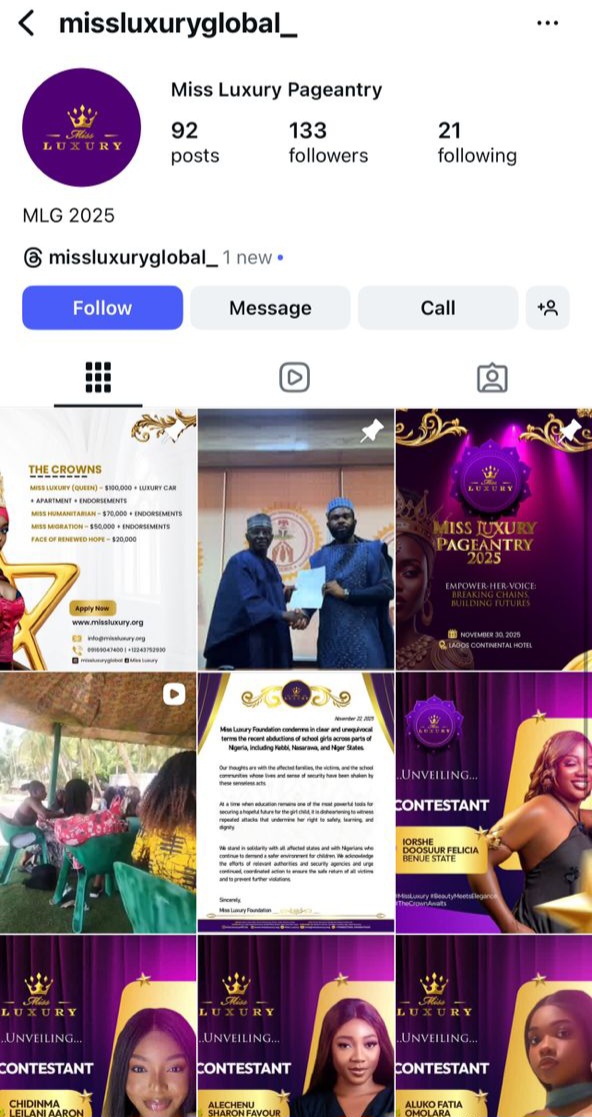
What was promoted as a luxury beauty pageant promising empowerment, exposure, and national representation has collapsed into one of the most controversial pageantry disputes in recent times, leaving behind allegations of exploitation, financial loss, emotional distress, and unanswered questions.
An extensive investigation by First Daily into the Miss Luxury Pageant reveals a deeply polarised narrative: contestants accusing organisers of gross mismanagement and deception, while organisers deny wrongdoing, insist no money was taken, and claim they were victims of sabotage by modelling agencies.
Crucially, despite repeated assurances and multiple opportunities to clarify their position, the organisers have failed to produce documentary evidence to substantiate their claims; raising further questions about transparency and accountability.
The Promise: A Nationwide Luxury Pageant
The Miss Luxury Pageant was presented as a high-profile, nationwide initiative designed to feature 37 contestants representing Nigeria’s 36 states and the Federal Capital Territory. According to organisers, the project extended beyond a beauty contest to include leadership training, professional grooming, and humanitarian engagement.
This public narrative was reinforced on October 24, 2025, when Premium Times published an article announcing the debut of the Miss Luxury Pageantry. In that report, organisers stated that the maiden edition would hold on November 4, 2025, at the Lagos Continental Hotel, and would be organised in partnership with several prominent institutions, including the National Commission for Refugees, Migrants and Internally Displaced Persons (NCFRMI), the Federal Ministry of Humanitarian Affairs, the United Nations, the International Commission for Peace and Good Governance, and the United Towns Agency.
The organisers also announced extraordinary prizes, including $100,000 cash, a luxury car, a luxury home, international fashion week appearances, and long-term modelling and endorsement contracts.
For many contestants, these public claims—now permanently on record—gave the project credibility.
“I checked their Instagram page. I didn’t immediately notice anything wrong,” said Amaka, one of the contestants. “I told myself that since this was their first time, maybe some things weren’t fully set up yet.”
Others said they joined based on recommendations from trusted figures in the industry.
“I joined because of the class of people that called me,” said one contestant who requested anonymity. “They are people of calibre—political, high-profile people. That gave me confidence.”
Early Red Flags: Shifting Dates and Silence
Despite the public claim that the event would be held on November 4, contestants say the first major red flag was the repeated postponement of both the camp and the grand finale.
Sharon Alechenu, another contestant, told First Daily:
“The camp was supposed to be on November 3rd. I booked my flight. Then a day before my flight, close to midnight, I was told the camp had been moved to December.”
She said rescheduling her flight attracted extra charges and forced her to abandon other professional commitments.
Another contestant, Damilola Omoloye, said:
“When we joined in October, the grand finale was supposed to be in November. It was postponed to December, and we waited patiently.”
Contestants also complained that questions raised in group chats were often ignored or shut down.
“Whenever we asked questions, the group would be restricted,” Amaka said. “Information was only shared when they wanted us to take action.”
The Camp: Intensity, Confusion, and Alleged Improvisation
Camp activities eventually commenced in early December—nearly a month after the date publicly advertised by organisers.
Contestants were first lodged in apartments around Jakande before being moved to La Campagne Tropicana, Ibeju-Lekki, a location several hours from central Lagos.
Several contestants described the camp as chaotic and exhausting.
“We would rehearse till 2 a.m., sometimes 3 a.m.,” Sharon said.
“We were putting in so much effort, not knowing the show would never hold.”
Others alleged inadequate feeding and lack of clear schedules.
“One of the trainers tried to put things together, but there was no food,” Amaka alleged.
“We were told we wouldn’t eat until Monday.”
Contestants also raised concerns about being asked to present deeply personal social-impact project ideas without clarity on ownership or safeguards.
“These projects are our babies,” Amaka said. “There was fear they could be taken or misused.”
The Grand Finale That Never Happened
December 10, 2026 was eventually presented to contestants as the climax—the grand finale, which organisers had earlier publicly said would take place at the Lagos Continental Hotel.
According to contestants, the day began with confusion.
“We were supposed to leave early,” Sharon said.
“The show was for 5 p.m. But the bus didn’t come.”
Several contestants alleged they were prevented from leaving La Campagne Tropicana because organisers had not settled outstanding accommodation bills.
“We were held there,” Sharon said. “The driver came but wasn’t allowed to pick us because payment hadn’t been completed.”
Another contestant described the experience more bluntly:
“They held us hostage. Nobody was allowed to leave until the money was paid.”
By the time they eventually departed, it was already late afternoon.
Agungi, Not Continental
Instead of heading to the Lagos Continental Hotel—publicly advertised in national media—the contestants said they were driven to a hotel in Agungi, miles away from the announced venue.
“At that point, I knew something was wrong,” said the anonymous senior contestant.
“Agungi is far from Continental Hotel, especially during traffic.”
Hours passed—5 p.m., 6 p.m., 7 p.m.—with no confirmation that the event would still hold.
Then came the message.
“They created another group,” Damilola said.
“They dropped a letter saying the event had been cancelled. No apology. Nothing.”
Shortly afterward, contestants say communication channels were restricted again, and the Miss Luxury Instagram account was made private.
The Fallout: Losses and Anger
The emotional and financial toll, according to contestants, was devastating.
“I lost my job a day before the grand finale,” Amaka said.
“Others missed school, contracts, and international events.”
One contestant said she abandoned her university convocation in Togo and turned down international judging roles to attend the pageant.
“What did I get in return?” she asked.
“A whole bunch of disrespect.”
The Organiser Speaks: ‘No Fraud Here’
When First Daily contacted the pageant’s CEO, Mr. Edidiong Udoidiong, he strongly rejected allegations of fraud.
“Fraud means somebody took money,” he said.
“None of them paid a dime. They came in for free.”
He insisted the organisers covered all major expenses.
“I paid for their clothes, accommodation, logistics—everything.”
According to him, the event was cancelled because only 11 contestants showed up out of the expected 37.
“We could not take 12 girls to the stage for a nationwide pageant,” he said.
“That alone ruined the vision.”
On Fees, Refunds, and ₦1 Million Compensation
Mr. Edidiong admitted that six contestants paid ₦50,000 each out of a proposed ₦200,000 fee, but said the money was refunded.
He further claimed:
“I gave ₦1 million to be shared among the girls.”
However, the man identified as the intermediary, whose name was put simply as Alhaji, denied receiving such funds.
“Who said he gave me ₦1 million?” Alhaji asked.
“I withdrew from this project a long time ago.”
Verification Attempts and Conflicting Accounts
To verify Mr. Edidiong’s claims, First Daily requested supporting evidence and independent confirmation. In response, the CEO provided contact details of three individuals—Solomon Akeh, who served as the Project Manager, Eze Okocha, the Digital and Publicity Lead, and one he simply gave his name as Alhaji. These, he identified as organisers who worked with him on the Miss Luxury Pageant and could corroborate his account.
However, attempts to independently verify these claims produced conflicting results.
Eze did not answer repeated phone calls and failed to respond to text messages and WhatsApp inquiries sent by First Daily over several days.
Solomon, described as a senior organiser, spoke with First Daily and confirmed his involvement in the project. During the conversation, he promised to provide documentary evidence, including receipts, invoices, and payment records, to substantiate the organisers’ claims. Despite repeated follow-up calls and messages, he failed to provide any of the promised documents as of the time of publication.
Alhaji, whom Mr. Edidiong identified as an intermediary involved in coordination and compensation, categorically denied active involvement in the project. Speaking with First Daily, Alhaji said he had withdrawn from the Miss Luxury Pageant earlier, citing the death of his father as the reason for stepping away.
“I pulled out of the project after my father died,” Alhaji said, adding that he was not involved in the final organisation or execution of the event.
These conflicting accounts further complicate the organisers’ narrative and underscore the difficulty in independently verifying key claims made by Miss Luxury management.
Staff Account: ‘The Project Held, Only the Crowning Failed’
A senior organiser, Solomon, earlier supported the CEO’s account in part.
“The event was not just about crowning,” he said.
“Training, grooming, networking—all of that held successfully.”
He attributed the cancellation to low turnout.
“Out of 36 states, we needed at least 17 contestants. We had 11.”
Contradictions Multiply
Despite these assurances, several contradictions remain unresolved—now sharpened by the Premium Times publication:
Venue: Publicly advertised Lagos Continental Hotel vs contestants’ account of being diverted to Agungi
READ ALSO: Mexico’s Fátima Bosch Crowned Miss Universe 2025 Amid Pageant Drama
Date: Nationally reported November 4 event vs December cancellation
Partnerships: High-level institutions named publicly vs no visible presence or documentation during camp
Capacity: Promised $100,000 prizes and luxury homes vs perceived inability to settle hotel bills
Compensation: Claimed ₦1 million shared vs intermediary denial
Communication: Public media engagement vs internal communication lockdown
The Missing Evidence
During interviews, both Mr. Edidiong and Solomon repeatedly promised to provide:
Venue payment receipts
Accommodation invoices
CAC registration documents
Partnership and endorsement letters
However, none of the promised documents has been produced as of the time of this report.
First Daily can confirm that follow-up messages were sent and calls placed, but no invoices, receipts, or official documents were received.
This failure to substantiate key public and private claims significantly weakens the organisers’ defence.
Conclusion: A Story Still Unfinished
The Miss Luxury Pageant controversy is no longer just about a cancelled event—it is about public representations versus private realities.
With claims now documented in a national newspaper and contradicted by participant testimonies, the burden of proof on the organisers has grown heavier.
Until documentary evidence is produced, critical aspects of the Miss Luxury narrative remain unverified.
First Daily will continue to pursue this story in the public interest.