
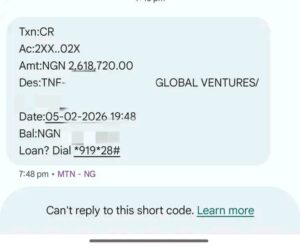
A police constable in Borno State, Mohammad Alhaji Muhammad, has said his decision to return ₦2.6 million mistakenly credited to his bank account was motivated by a desire to improve public perception of the Nigeria Police Force.
The officer, attached to the insurance office of the Borno State Police Command, received the unexpected alert last Thursday but immediately recognised that the funds were not meant for him.
According to the Police Public Relations Officer in the state, ASP Nahum Daso, Muhammad promptly reported the incident to his bank the following morning and requested that the transaction be investigated and reversed.
“He knew he was not expecting any money. On Friday morning, he took permission and went straight to his bank to complain that the funds were wrongly sent to him,” Daso said in a telephone interview on Monday.
The bank later traced the source of the transfer to a United Bank for Africa branch in Sokoto and contacted the branch manager.
Muhammad subsequently signed a consent form authorising the reversal of the ₦2.6 million to the rightful owner, identified as a Moniepoint customer.
The action drew public commendation after Bello Jafar shared the story on Facebook, describing Muhammad as a police officer of exceptional integrity.
READ ALSO: Defend Force With Professionalism, Integrity, IG Tells Police Lawyers
Confirming the development, Daso said the Borno State Commissioner of Police, Naziru Abdulmajeed, invited the constable for a meeting, during which Muhammad explained that he acted out of professional discipline and a commitment to ethical conduct.
“When asked why he refused to keep the money, he said he is a policeman and understands the negative notions many people have about the police. He wanted to prove that officers can act with integrity,” Daso added.
The officer’s conduct has been widely praised as a rare display of honesty, reinforcing calls for ethical standards within the force and highlighting the positive impact of individual actions on public trust.