In an era where digital archives are permanent, the journey of personal evolution has become a public battleground.
Over the past weeks, Nigerian singer-songwriter Simi has navigated a complex intersection of advocacy and scrutiny. What began as a firm condemnation of sexual violence transitioned into a polarizing debate as critics resurfaced decade-old tweets to challenge her current stance. To understand this moment, one must look past the immediate outrage and examine the trajectory of an artist who has spent nearly two decades growing in the public eye.
From Gospel Beginnings to Mainstream Stardom
Born on April 19, 1988, in Lagos, Nigeria, Simisola Bolatito Kosoko (née Ogunleye), professionally known as Simi, built her creative foundation within the church. While she initially entered the music scene with her debut gospel project, Ogaju, in 2008, it was her eventual transition into a signature blend of soulful R&B and Afropop that redefined her career and established her as a household name.
With hits such as Tiff and Jamb Question, and critically acclaimed albums like Simisola and To Be Honest, she established herself as a storyteller unafraid of vulnerability.
In an industry often driven by artifice, Simi built a brand rooted in plain-spoken honesty and conversational lyricism.
Love, Marriage, and Public Partnership
In 2019, Simi married fellow musician Adekunle Gold in a private ceremony, forming one of the most respected creative partnerships in Nigerian entertainment. The couple, known for their seamless musical collaborations and grounded public image, welcomed their daughter, Deja, in 2020.
Adding to their shared legacy, the couple recently captivated audiences with a sophisticated music video pregnancy announcement.
This creative reveal served as a celebration of their expanding family while maintaining their signature blend of art and intimacy. The milestone further solidified Simi’s public identity as a woman balancing the complexities of motherhood with a high-profile career.
A Strong Voice Against Sexual Violence
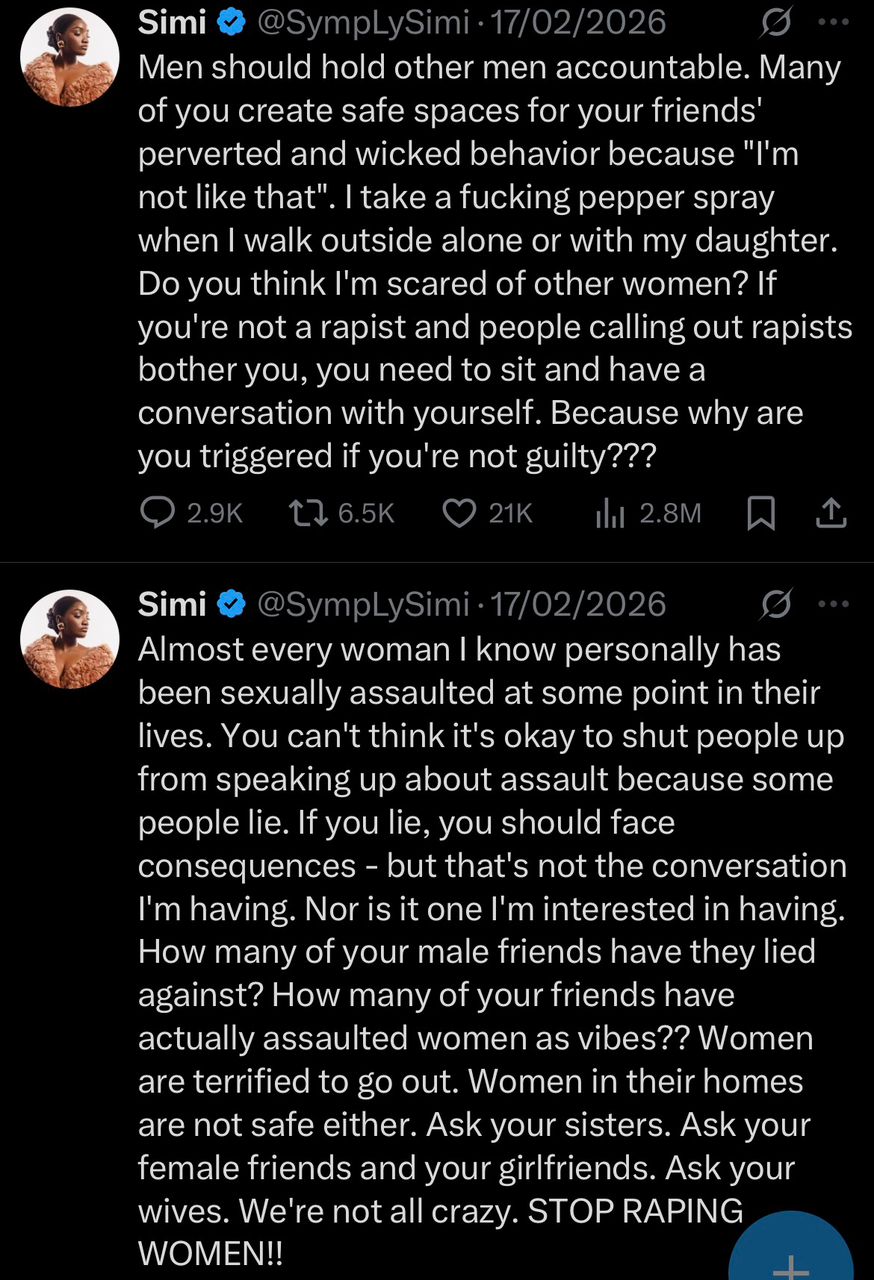
Simi’s recent advocacy for women’s safety has been notably vocal. She utilized her platform on X (formerly Twitter) to demand systemic accountability and severe consequences for sexual offenders, stating that rapists should be “castrated and burned”.
The discourse shifted dramatically when a user, Pablo Martini, responded to her call for justice by asking, “Dear Simi, what about false rape accusers?”.
Simi rejected this line of questioning, viewing it as a diversion from the life-threatening reality of sexual assault. She countered by asking how the issue of false accusations related to the specific conversation about ending rape, eventually dismissing the provocations with a firm “Stfu” to those attempting to shift the focus.
This confrontational defense of her stance became the catalyst for a “faceless mob” to begin a deep-dive into her digital history.
Old Tweets, New Backlash
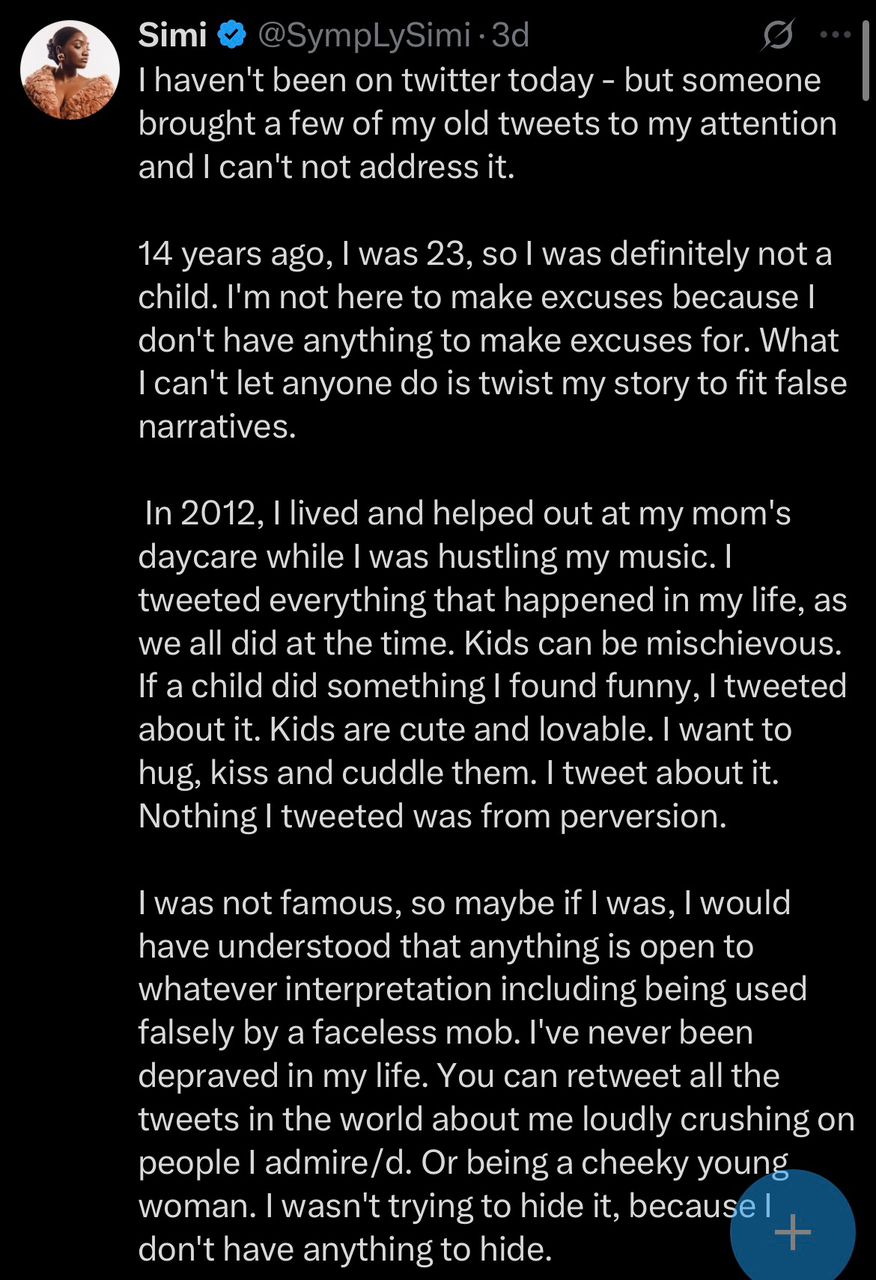
Within hours of the exchange, screenshots from 2012—when Simi was 23—surfaced. These posts, which described her affectionate interactions with children at her mother’s daycare, were stripped of their original context and framed by some as inappropriate.
Simi proactively addressed the resurfaced content, explaining that she was a young woman “hustling” her music career at the time while supporting her family’s business. She clarified that her mentions of hugging or “cuddling” children were expressions of innocent, maternal affection for the kids she helped care for.
READ ALSO: Lagos Police Probe Simi’s Old Tweets Amid Child Abuse Allegations
“Nothing I tweeted was from perversion,” she stated, adding that as a non-famous youth, she did not anticipate that her everyday life would one day be “used falsely by a faceless mob”.
Her team eventually opted to delete the sensitive tweets to shield her family from the fallout, though Simi expressed a personal preference to leave them up, maintaining that she has nothing to hide.
The Internet and the Question of Growth
This controversy brings a critical professional question to the forefront: Is there room for growth in a culture of permanent records? As public calls for an investigation intensified following the resurfaced posts, the Lagos State Domestic and Sexual Violence Agency (DSVA) intervened. The agency issued a statement urging any alleged survivor to come forward, providing a formal channel for accountability amid the digital noise.
Despite this move and the high-volume online discourse, it remains a fact that there have been no legal allegations, formal charges, or criminal evidence brought against Simi.
The artist remains steadfast in her position, refusing to let past tweets invalidate her current advocacy. “I’ve never claimed to be perfect,” she noted, “I said stop raping women. I stand by it”.
A Moment, Not a Definition
Regardless of the digital turbulence, Simi’s impact on Nigerian music remains a cornerstone of the modern industry. She represents a generation of female artists who are thinkers and advocates as much as they are performers.
For Simi, this chapter is another layer in a multifaceted journey of faith, fame, and family. As the industry continues to evolve, her story serves as a case study in navigating the unforgiving nature of the digital era—where a woman’s voice can spark both widespread admiration and intense investigation in the same breath.